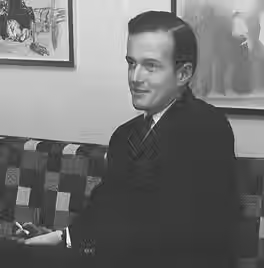
Updated: 4 days ago

Imagine sitting down at a piano in the 1920s, when audiences still expected music to offer recognizable melodies, familiar harmonies, and perhaps a satisfying resolution at the end. Now imagine a young American woman who seemed increasingly determined to give them none of those things.
That woman was Ruth Crawford Seeger, one of the most original, adventurous, and uncompromising composers in American musical history.
At a time when many composers were still looking to Europe for artistic direction, Crawford was helping create an entirely new musical language. Her compositions could be mysterious, dissonant, rhythmically unpredictable, and startlingly beautiful. She was fascinated by the possibilities of sound itself—how a single note could change character depending on its surroundings, how silence could generate tension, and how musical lines could move independently while forming an intricate larger structure.
Yet there is a wonderful contradiction at the heart of her story. The same woman who wrote some of the most challenging American music of the early twentieth century would later become one of the nation's most important preservers of traditional folk songs, producing collections that generations of American children would sing from.
Her life encompassed two seemingly opposite musical worlds: the experimental concert hall and the simple folk melodies passed from one generation to the next. Remarkably, she made important contributions to both.
For pianists, her surviving compositions offer something especially fascinating. Written primarily during the 1920s and early 1930s, they document the transformation of a talented young musician into a fearless modernist whose ideas remain fresh and provocative nearly a century later.
From Ohio to Florida: A Young Musician Finds Her Direction
Ruth Porter Crawford was born on July 3, 1901, in East Liverpool, Ohio. Her father, Clark Crawford, was a Methodist minister, and the family moved several times during her childhood before eventually settling in Jacksonville, Florida.
Music was an important part of Ruth's upbringing, but so was literature. As a teenager, she wrote poetry and stories, revealing an imaginative and introspective personality that would later find expression in her compositions.
Following her father's death in 1914, the family faced financial challenges. Ruth pursued her musical education while developing the practical skills necessary to support herself. She studied piano and eventually began teaching, initially envisioning a relatively conventional musical career.
At the time, teaching piano was one of the more dependable career paths available to a musically talented young woman. Composing experimental music that challenged nearly everything audiences expected was considerably less dependable.
But Ruth's ambitions were beginning to extend well beyond the piano studio.
In 1921, she moved to Chicago to attend the American Conservatory of Music. The decision would transform her life.
Chicago: Where Things Got Interesting
Chicago in the 1920s was an exciting place to be a musician. Jazz was flourishing, skyscrapers were transforming the skyline, and the city possessed a restless energy that seemed to encourage artistic experimentation.
At the American Conservatory, Crawford studied composition and theory with Adolf Weidig, a teacher who encouraged her developing interest in writing music. She also studied piano with Djane Lavoie Herz, an influential musician whose interests extended far beyond conventional keyboard repertoire.
Herz had been associated with the musical world of Alexander Scriabin, the Russian composer whose later works explored extraordinary harmonic colors, mystical ideas, and unconventional musical structures.
For Crawford, this was an introduction to an entirely different way of thinking about music.
Through Herz and Chicago's progressive artistic circles, she encountered composers and thinkers such as Henry Cowell and Dane Rudhyar. Cowell, in particular, was an important champion of experimental American music, and he would eventually help bring Crawford's compositions to a broader audience.
Suddenly, music was no longer simply a matter of writing attractive melodies supported by pleasing harmonies. It could be an investigation into entirely new relationships between sounds.
Crawford was especially drawn to the possibilities of dissonance. What if two musical lines could retain their independence without being forced into conventional harmonic relationships? What if rhythm, texture, and dynamics became just as important as melody?
These were not merely theoretical questions. She began exploring their answers at the piano.
The results would become some of the most distinctive keyboard music written by an American composer during the 1920s.
The Early Piano Pieces: A Surprisingly Playful Beginning
One of the pleasures of exploring Crawford Seeger's piano music is discovering that her earliest compositions are not nearly as intimidating as her later reputation might suggest.
In fact, some have wonderfully playful titles.
Little Waltz (1922), considered her earliest surviving composition, offers a glimpse of the young composer's emerging personality. Other early works include Little Lullaby, Jumping the Rope (Playtime), Whirligig, Caprice, and the delightfully named Mr. Crow and Miss Wren Go for a Walk.
That last piece even carries the descriptive subtitle A Little Study in Short Trills.
These miniature compositions reveal a side of Crawford that is sometimes overshadowed by her later experimental achievements: a musician with a sense of humor, an affection for concise musical characterization, and an ability to create engaging pieces from relatively simple material.
The titles suggest familiar childhood activities, small domestic scenes, and whimsical characters. Yet even in these modest works, Crawford was beginning to explore unusual melodic turns, unexpected harmonies, and imaginative rhythmic gestures.
By 1923, she was also tackling more substantial musical forms, including a Piano Sonata and Theme and Variations.
These compositions demonstrate her command of traditional musical architecture. She understood sonata form, variation technique, and counterpoint, and she could employ them with considerable skill.
That understanding would become important as her musical language developed. Crawford was not abandoning traditional composition because she lacked the ability to write it.
She was moving beyond it because she wanted to discover what else music might become.
Kaleidoscopic Changes: The Emerging Modernist
A particularly revealing milestone arrived in 1924 with Kaleidoscopic Changes on an Original Theme, Ending with a Fugue.
Even the title hints at Crawford's increasingly adventurous imagination.
The work takes a familiar concept—a theme transformed through a series of variations—and approaches it with an unusually exploratory spirit. Musical ideas change character, harmonic colors shift, and contrasting textures give the impression that the same musical material is being viewed from different angles.
It is an appropriate musical equivalent of a kaleidoscope: the underlying elements remain connected, but their relationships keep changing.
The concluding fugue demonstrates that Crawford retained a strong command of traditional contrapuntal technique, even as she experimented with increasingly unconventional harmonies.
Her Five Canons, also written in 1924, provide another example of her fascination with the independence of musical lines. Some are extraordinarily brief, compressing contrapuntal ideas into miniature statements.
These works mark an important transitional period. Crawford was becoming less interested in music as a sequence of familiar harmonic events and more interested in the intricate relationships among individual voices, gestures, and sounds.
It was an approach that would soon find its fullest expression in her piano preludes.
Nine Preludes for Piano (1924–1928): A Composer Discovers Her Voice
If one were to choose a single group of compositions through which to understand Ruth Crawford Seeger's development as a pianist-composer, the Nine Preludes for Piano would be an excellent place to begin.
Written over approximately four years, the preludes represent a remarkable artistic journey. The first five were composed in 1924–1925, while the remaining four followed in 1927–1928.
They are not grand concert works designed to dazzle audiences with sweeping virtuosity. Instead, they are highly concentrated explorations of harmony, rhythm, texture, and musical color.
Many are quite short, but their brevity can be deceptive. A single prelude might contain more unusual musical ideas than a much longer conventional composition.
In the earlier preludes, Crawford still allows occasional lyrical gestures to emerge. Prelude No. 1 combines winding chromatic lines with passages that suggest the rhythmic freedom and harmonic colors of jazz. Prelude No. 3 offers moments of expressive melody before introducing contrasting, more rhythmically animated material.
Yet even when the music sounds lyrical, it rarely behaves predictably.
Harmonies refuse to settle where the ear expects them to go. Melodic lines twist in unexpected directions. Rhythmic patterns appear, shift, and disappear.
As the series progresses, Crawford's language becomes increasingly individual.
Rather than offering listeners a recognizable theme and then developing it in familiar ways, she begins constructing musical experiences from contrasts of register, intensity, motion, and color.
The piano becomes less a vehicle for conventional melody and accompaniment and more an instrument capable of creating extraordinary sonic landscapes.
Prelude No. 6: A World of Sound in Miniature
Prelude No. 6, composed in 1927, is among the most fascinating works in the collection.
Its opening unfolds through delicate, dissonant sonorities that seem almost suspended in the air. There is a mysterious quality to the music, as though the listener has entered a world where familiar harmonic relationships no longer apply.
But the piece is far from static.
Broad arpeggiated gestures expand the musical space, interrupting and transforming the more delicate opening textures. Crawford makes striking use of the piano's enormous range, eventually creating contrasts between its lowest and highest registers.
The effect is surprisingly dramatic for such a compact composition.
What makes this prelude especially compelling is the way its emotional character remains difficult to define. At moments, the music seems fragile and intimate. Elsewhere, it acquires an almost monumental intensity.
Its beauty does not depend on a memorable tune or a satisfying harmonic resolution. Instead, it emerges from the relationships among individual sounds and the spaces separating them.
For the performer, the challenge is not simply to play the correct notes. It is to give every gesture its proper weight, allowing subtle changes of color, dynamics, and timing to shape the musical experience.
Prelude No. 8: Rhythm Takes Center Stage
If Prelude No. 6 explores the expressive possibilities of texture and sonority, Prelude No. 8 reveals Crawford's fascination with rhythmic energy.
This is a livelier, more animated work, filled with sharply articulated gestures, unexpected accents, and restless movement.
Leaping intervals and shifting rhythmic patterns keep the music in almost constant motion. There are even fleeting suggestions of dance rhythms, although Crawford quickly transforms them into something far removed from the ballroom.
The piece can feel playful one moment and fiercely determined the next.
It is also an excellent illustration of her ability to create excitement without relying on the familiar vocabulary of Romantic virtuosity. Rather than filling the keyboard with torrents of conventional passagework, she generates momentum through the precise interaction of brief musical ideas.
There is a wonderfully unpredictable quality to the result. Just when the listener begins to understand a rhythmic pattern, Crawford seems ready to disrupt it.
Prelude No. 9: A Mysterious Conclusion
The final prelude takes the listener into an entirely different musical atmosphere.
Deep, resonant notes suggest distant bells or gongs, while chromatic lines unfold above them. The music possesses an almost ritualistic quality, alternating between mysterious restraint and fuller, more imposing sonorities.
By this point in the series, Crawford has traveled an extraordinary distance from the musical world of her earliest compositions.
The familiar conventions of tonal harmony have largely disappeared. What remains is a deeply personal musical language in which individual sounds, intervals, and textures carry enormous expressive significance.
Taken together, the Nine Preludes are far more than exercises in modernist technique. They are a vivid record of a composer discovering new possibilities at the keyboard.
New York, Charles Seeger, and a Remarkable Achievement
By the late 1920s, Crawford's reputation was growing among America's experimental musical community.
Henry Cowell had become an important supporter, helping promote her compositions through performances and publication. Her music was attracting attention not because it followed established fashions, but precisely because it did not.
In 1929, she left Chicago for New York, where she entered another influential circle of composers, performers, and musical intellectuals.
There she met Charles Seeger, a prominent composer, theorist, and musicologist. Crawford began studying with him in November 1929, and their intellectual and personal relationship would profoundly influence the remainder of her life.
Seeger was particularly interested in the possibilities of dissonant counterpoint—a compositional approach in which independent musical lines could be organized without relying on traditional consonance and tonal harmony.
For Crawford, these ideas provided new ways to develop interests she had already been exploring.
Then came a major professional breakthrough.
In 1930, at just 28 years old, Ruth Crawford became the first woman awarded a Guggenheim Fellowship specifically for musical composition.
The fellowship supported her travels and studies in Europe, placing her among the most promising American composers of her generation.
It was a remarkable achievement, particularly at a time when women composers still faced substantial barriers to recognition.
Her most celebrated period of composition had begun.
Piano Study in Mixed Accents (1930): Ninety Seconds of Controlled Chaos
Of all Crawford Seeger's piano compositions, Piano Study in Mixed Accents may be the most immediately startling.
Written in 1930 and published in 1932 through Henry Cowell's New Music series, the piece typically lasts only about a minute and a half.
But what an extraordinary minute and a half it is.
The composition takes a seemingly straightforward musical idea—the placement of accents—and turns it into the driving force of an entire work.
In conventional music, listeners generally develop a sense of where strong beats belong. Even when rhythms become complicated, there is often an underlying pattern that helps organize the experience.
Crawford delights in disrupting that expectation.
Accents shift unexpectedly, giving the impression that the music is continually changing its balance. Short, sharply defined gestures create rhythmic tension, while rapidly changing patterns challenge the listener's sense of a stable pulse.
The result can sound almost mechanical, yet the music possesses tremendous vitality.
One might imagine a complicated machine in which the individual parts are all operating perfectly but their movements combine to produce an unpredictable, exhilarating rhythm.
For the pianist, the piece requires exceptional precision. Accents must be carefully controlled, and the performer must resist the temptation to smooth out the music's deliberate irregularities.
Its concentrated energy also makes it surprisingly entertaining. There is something almost mischievous about the way Crawford continually shifts the listener's rhythmic expectations.
It is modernism with a sense of adventure.
Despite its brevity, Piano Study in Mixed Accents stands as one of the most distinctive American piano works of its period and a particularly revealing example of Crawford's mature compositional thinking.
The String Quartet of 1931: A Modernist Masterpiece
Crawford's innovative ideas were not confined to the piano.
Her String Quartet 1931 is widely regarded as her greatest achievement and one of the landmark compositions of early American modernism.
The work explores extraordinary relationships among four independent instruments, treating musical lines, dynamics, and timbres as elements of a complex and continually evolving structure.
Its famous third movement creates a remarkable sense of motion and intensity through the coordinated shaping of sustained tones and changing dynamics.
Much of what Crawford had been exploring in her piano works—the independence of individual voices, the expressive possibilities of dissonance, and the importance of musical texture—finds an even more ambitious expression in the quartet.
By the early 1930s, she had established herself as a composer with a genuinely original voice.
And then, just as her creative powers seemed to be reaching their peak, her career took an unexpected turn.
From Avant-Garde Composer to Folk Music Pioneer
In October 1932, Ruth Crawford married Charles Seeger.
Their household would eventually become one of the most musically influential families in twentieth-century America.
Charles already had children from his previous marriage, including Pete Seeger, who would become one of the country's most famous folk musicians. Ruth and Charles also had four children together, among them Mike and Peggy Seeger, both of whom would develop important careers in traditional music.
Music was not simply a profession in the Seeger household. It was woven into daily life.
But raising a large family placed considerable demands on Ruth's time. Her priorities also began changing as she became increasingly interested in American folk traditions and their cultural importance.
During the 1930s, her output of experimental concert music diminished dramatically.
It would be easy to interpret this shift as a brilliant composer abandoning her artistic ambitions. The reality was more complicated.
Crawford became fascinated by the songs ordinary Americans had sung for generations: work songs, ballads, spirituals, children's songs, and regional musical traditions that had often been passed down without written notation.
Much of this music existed primarily in recordings, memories, and oral traditions. Unless someone made the effort to document it, valuable musical history could disappear.
Crawford brought the same intense listening, precision, and intellectual curiosity to this work that she had once devoted to experimental composition.
She became particularly skilled at transcribing folk performances, carefully capturing melodic inflections, rhythmic details, and other characteristics that conventional notation might overlook.
Her work with the pioneering folk-song collectors John and Alan Lomax was especially significant.
For their influential 1941 collection Our Singing Country, she transcribed 205 folk tunes, helping transform field recordings into a musical resource that could be studied, performed, and preserved.
There is a striking continuity between these activities and her earlier compositions.
The composer who had once explored the smallest relationships among notes was now listening just as carefully to the subtle details of traditional American singing.
The musical worlds were different, but the attentive ear behind them was the same.
Bringing America's Songs Into the Classroom
One of the most delightful chapters of Crawford Seeger's later life involved teaching music to young children.
A particularly revealing episode occurred when she began working with children in a nursery-school setting. Initially uncertain about the experience, she discovered how naturally children responded to traditional songs.
A singing activity involving Mary Wore Her Red Dress, adapted to include the names and clothing of individual children, helped convince her of the remarkable possibilities of folk music in early education.
She became increasingly committed to introducing children to the musical traditions of their own country.
In 1948, she published American Folk Songs for Children, a collection of more than ninety traditional songs intended for families, teachers, and young students.
The book drew on a rich variety of American musical traditions, including singing games, work songs, ballads, spirituals, and blues.
Other collections followed, including Animal Folk Songs for Children (1950) and American Folk Songs for Christmas (1953).
These publications were enormously important to American music education.
They also revealed a different kind of musical artistry. Crawford possessed a gift for presenting traditional melodies clearly and sensitively, often with accompaniments that respected the character of the original songs.
There is something rather wonderful about this part of her career.
The woman who had once written piano music capable of challenging the most sophisticated musicians in America was now helping children discover the pleasures of singing Froggie Went A-Courtin' and Bought Me a Cat.
And she approached both musical worlds with equal seriousness.
A Return to Composition—and a Life Cut Short
Although Crawford devoted much of her later life to folk music, her interest in experimental composition never completely disappeared.
By the late 1940s and early 1950s, she was beginning to consider a return to the compositional world she had helped transform two decades earlier.
In 1952, she completed her Suite for Wind Quintet, an important return to original concert composition after many years.
It suggested that her creative journey was not necessarily finished—that there might still be new compositions, new experiments, and new discoveries ahead.
Tragically, that possibility was cut short.
Crawford was diagnosed with cancer and died in Chevy Chase, Maryland, on November 18, 1953, at the age of just 52.
Her death ended a remarkable musical life that had moved from the avant-garde circles of Chicago and New York to the preservation of America's traditional folk heritage.
At the time, her modernist compositions were still relatively unfamiliar to most concert audiences.
It would take decades for the full significance of her work to become widely appreciated.
Rediscovering Ruth Crawford Seeger
Today, Ruth Crawford Seeger occupies a distinctive position in American musical history.
She is recognized as a central figure among the American experimental composers of the early twentieth century, alongside such innovators as Henry Cowell, Charles Ives, and Carl Ruggles.
Her String Quartet 1931 has become an important work in the modern chamber repertoire, while her piano compositions continue to attract performers interested in music that challenges conventional expectations.
Yet her piano music remains less familiar than it deserves to be.
Part of the reason may be that these works resist easy categorization.
They are not comfortably Romantic, yet they are not emotionally empty exercises in musical mathematics. They can be severe, witty, lyrical, mysterious, playful, and deeply expressive—sometimes within the space of a single minute.
They also demand an unusual kind of listening.
In a Chopin nocturne, the ear may follow a beautiful melody supported by familiar harmonic movement. In a Crawford Seeger prelude, the listener may instead become aware of the precise placement of a dissonant chord, the way one register answers another, or the extraordinary tension created by a brief interruption in the musical texture.
Her works invite us to notice things we might otherwise overlook.
For the pianist, they offer an equally rewarding challenge. Technical accuracy is essential, but so is an understanding of how tiny musical details contribute to the larger design. A misplaced accent, an overlooked dynamic change, or an insufficiently differentiated tone color can fundamentally alter the character of a passage.
What makes Crawford Seeger's story especially compelling is that her extraordinary musical curiosity never truly disappeared. Whether she was writing a radically modern piano prelude, constructing an intricate string quartet, or transcribing a traditional Appalachian ballad, she approached music as something worthy of the closest possible attention.
She believed, through her work, that meaningful musical discoveries could be made both by inventing entirely new sounds and by listening more carefully to the songs people had been singing for generations.
Her piano works remain among the most fascinating documents of that first journey—brief, concentrated, uncompromising, and still capable of surprising anyone willing to listen.
Selected Performances
Prelude #6 - The Nine Preludes for Piano (1924–1928) trace this evolution with remarkable clarity. By the time we arrive at Prelude No. 6 (1927–1928), Crawford Seeger has entered a fully mature phase of her early style. The piece is spare yet intense, built from sharply etched gestures and an almost sculptural sense of silence. Rather than relying on conventional melody and harmony, she creates tension through registral contrast, dissonant sonorities, and the careful placement of isolated tones.
What makes Prelude No. 6 so compelling is its emotional ambiguity. It can feel at once fragile and severe—intimate, yet distant. The music unfolds less like a narrative and more like a series of suspended moments, each one delicately balanced. In this way, Crawford Seeger invites the listener into a different mode of attention: one that is less about expectation and resolution, and more about presence and perception.
Study in Mixed Accents - Ruth Crawford Seeger’s Study in Mixed Accents (1930) is a striking example of her innovative approach to rhythm and piano texture. Rather than relying on traditional melody, the piece is built around constantly shifting accents that disrupt any sense of regular pulse, creating a tense, almost mechanical energy.
The music unfolds as a study in contrast and control: sharply defined gestures and precise dynamic markings demand both technical command and rhythmic independence from the performer. The result is a highly concentrated, modernist work that challenges conventional expectations of phrasing and meter, embodying Crawford Seeger’s interest in pushing musical structure to its expressive limits.
Prelude #8 - Ruth Crawford Seeger’s Prelude No. 8 from the Nine Preludes is one of the set’s more animated and rhythmically alert pieces. Marked by a quicker tempo and a sense of forward drive, it features sharply etched gestures and a clear, almost restless momentum.
The writing emphasizes contrast and motion rather than stillness—short, pointed figures and shifting accents give the music a lively, kinetic edge. Even within its brief span, Crawford Seeger maintains tight structural control, balancing energy with precision, and demonstrating her early mastery of rhythmic vitality and modernist clarity.
Locating The Music
You can purchase Ruth Crawford Seeger's main piano compositions at Presser. In addition, you can download some of her piano music for free at IMSLP.
Solo Piano Compositions
Little Waltz — 1922
Little Lullaby — 1923
Jumping the Rope (Playtime) — 1923
Caprice — 1923
Whirligig — 1923
Mr. Crow and Miss Wren Go for a Walk — 1923
Kaleidoscopic Changes on an Original Theme, Ending with a Fugue — 1924
Five Canons — 1924
Preludes Nos. 1–5 — 1924–1925
Preludes Nos. 6–9 — 1927–1928
We Dance Together — 1926
Study in Mixed Accents — 1930